Find your path to success with a diverse range of more than 120 degree, certificate, and continuing education programs.
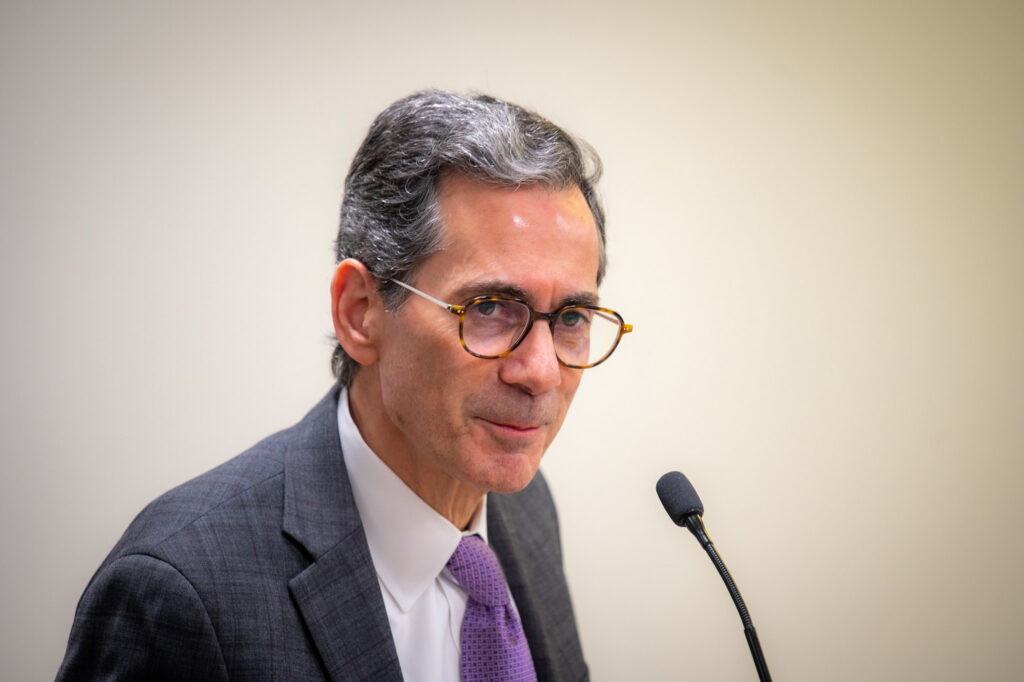
President Friedman has Bergen flying high after five years on the job.
When Bergen Community College President Eric M. Friedman, Ph.D., arrived for his first day five years ago, the silence on campus was deafening.
A pandemic will have that effect.
Taking the reins of the state’s largest community college in January 2021, Friedman faced a multifaceted challenge in establishing a foundation for his presidency and stabilizing the institution. With unemployment soaring, the fear of illness tethering people to their homes and an immediate pivot to virtual operations, enrollment tumbled at community colleges across the country. Once hubs of energy for their local communities, campuses paused their on-ground activity, hushing the vibrancy that make community colleges community centers.
These challenges complicated Friedman’s arrival – and now he had the responsibility for navigating Bergen through them. But before work could begin on addressing these issues, he would need to address a more fundamental problem: connecting with the trustees, the students, the staff, the faculty and the community stakeholders.
With Bergen operating remotely, Friedman could not introduce himself to the College community in a traditional sense. Absent were the face-to-face town halls, lunches with students and hallway conversations with faculty that he had once envisioned. Instead, he would make his debut from his office via a webcam. No matter how effective the technology, it could not close the distance between the president and his college.
These virtual interactions reinforced what Friedman already knew: a community college is defined by the community it builds and the community it serves. Community colleges thrive when they become centralized hubs for learners, industry partners and community members. Their campuses feature an unmistakable energy driven by the diverse tapestry of the people they serve. Connectedness became another victim of the virus.
As a first step in a world racked by the daily uncertainties of COVID-19, Friedman sought to connect with his community in any manner he could. He immediately launched what he called a “listening tour,” standing six-feet apart from faculty, staff, students, government officials, business leaders and community members to learn about his new institution, its needs and the people it served. He took time to develop these relationships, whether masked and armed with hand sanitizer, on the phone or remotely behind a webcam. Feedback remained essential as he not only navigated the College’s operations during the pandemic, but how he would lead the College through the crisis and position it for success on the other side.
“That’s how communities thrive,” he said. “When we listen to each other and work together in support of common goals.”
The listening tour made clear that connectedness and what Friedman called an “ethic of care” could help drive both the institution’s present and future. This ethos led Friedman to promise that he would make decisions through a lens of equity and compassion that would help students succeed, support faculty and staff through initiatives such as expanded professional development opportunities and community partnerships.
Five years later, Friedman’s vision has come to life – the halls are no longer silent, but the need for connectedness still echoes as a central focus in his presidency.
“Bergen has an incredible academic record,” he said. “We offer excellence in programs usually reserved for four-year colleges. We have a renowned faculty that help our students transfer to the best universities in the world. But it’s something else that makes Bergen especially different: students truly feel like they belong here.”
Bergen has once again become a bustling community center where more than 24,000 credit- and non-credit students now enroll. Friedman has architected a comprehensive strategic plan that has enhanced the institution’s student support services, workforce initiatives, and faculty and staff development. He has expanded revenue sources through grant programs, rebuilt frayed community and government partnerships and become one of the state’s leading voices on college affordability and workforce preparedness. He chairs the New Jersey Presidents’ Council Workforce Committee and serves on the Meadowlands Chamber of Commerce, the Commerce and Industry Association of New Jersey, the New Jersey Council of County Colleges Workforce Committee and the Bergen County Economic Resilience Committee.
“The last five years has featured an incredible amount of work designed to better support our students’ learning,” he said. “But for students to achieve success, it takes so much more. It takes a college committed to student success at all levels.”
Of all the work Friedman has completed in the last five years, a recent achievement may stand as the most important. Under the president’s steady hand, Bergen received a full, eight-year reaffirmation of its accreditation by the Middle States Commission on Higher Education. The periodic review assesses an institution’s mechanisms for effective operation. Bergen received specific commendations in numerous areas recognizing its approaches as best practices – many rooted in Friedman’s “ethic of care.” The accreditors praised the institution’s renewed commitment to its participatory and shared governance structure that ensures all members of the College community can voice their praise, opinions and concerns through Friedman’s establishment of the All College Forum, town hall meetings and Pizza with the President.
Other initiatives identified as best practices captured the attention of some high-profile observers.
In one of his first major projects as president, Friedman launched a multimillion-dollar tuition debt relief initiative that erased eligible students’ unpaid balances during the pandemic. The initiative enabled students to return to the College unburdened by outstanding debts and, thus, equipped to continue their academic progress and graduate. To foster success, the College developed a comprehensive support system featuring counselors, advisers and other single points of contact for students taking advantage of the program. The initiative also provided complimentary childcare in the on-campus Child Development Center and access to food, clothing and social services through the Bergen Cares Center. Former First Lady Jill Biden, Ed.D., and U.S. Secretary of Education Miguel Cardona, Ed.D., identified Bergen as an institution for others to model during a January 2022 visit to the Paramus campus.
This attention to holistic and wraparound support services enhanced the College’s existing portfolio that already included a nationally renowned tutoring center (the Cerullo Learning Assistance Center), advising and counseling, and the Sidney Silverman Library.
“There’s so much that goes into being a college student – especially a community college student,” Friedman said. “They work multiple jobs, care for family members and juggle disparate responsibilities. So, if we want our students to become successful, our support must follow them when they exit the classroom for the day.”
Friedman has now deployed technology to enhance Bergen’s student support and retention efforts as well. This year, the College partnered with Civitas, a higher education data solutions firm, to leverage the company’s proprietary software. Using artificial intelligence and data analytics, Bergen counselors and advisers will access custom-built dashboards with personalized recommendations for students – including early alerts that can prompt intervention and prevent negative outcomes.
“We know that individualized attention matters,” Friedman said. “But providing individualized advising and counseling to 24,000 students presents a challenge. That’s why we’re investing in the most innovative strategies in higher education to ensure students can remain enrolled and on a path for graduation.”
External partners, including those in Bergen County government, have fully embraced Friedman’s vision by committing additional financial support and collaborating on key workforce development initiatives. Among them, the highly successful “Bergen for Business” consulting program that has connected nearly 2,000 local entrepreneurs with the College’s “small business support specialists” – students who provide assistance developing websites, business plans and marketing initiatives.
County leaders also provided the seed funding to launch the innovative Center for Online Learning, which enables students to complete one of six in-demand degree programs entirely remotely. Friedman launched the initiative to broaden Bergen’s market base and respond to the pandemic-lingering desire for additional online education options.
Additionally, new shared services agreements have seen the College leverage county resources for tasks such as snowplowing and landscaping, creating efficiencies and saving money.
Bergen County Executive James J. Tedesco III said Friedman has outlined a clear vision for the state’s largest community college and positioned it for continued growth and success.
“President Friedman has been a transformational leader for Bergen Community College,” he said. “He is the best kind of partner – someone who collaborates, communicates and engages. We operate with a shared goal of not only preserving the College as one of the county’s crown jewels, but making it shine even brighter.”
While students, faculty and staff have come to know Friedman for his “ethic of care” approach, they have also recognized his commitment to another equally important pillar of his leadership: “continuous improvement.”
“Bergen is one of the nation’s great community colleges,” Friedman said. “But that doesn’t mean it can’t be even better. Jim Collins coined the phrase ‘good is the enemy of great.’ And I think that’s exactly right. The world is in constant motion – we are evolving with it. We have to find ways to get better every day without the complacency that often follows success.”
To this end, Friedman has worked closely with the College’s faculty to ensure academic programs contain linkages to the workforce through curricular innovation. Among the academic program enhancements, the College has begun developing programs in emerging fields such as data analytics and global supply chain management.
The Bergen Community College at the Meadowlands Innovation Center also stands as a prominent example of continuous improvement.
“For nearly 25 years, the College explored ways to enhance its offerings in southern Bergen County,” Friedman said. “That desire led to the 2008 purchase of a five-story office building in Lyndhurst that the institution called ‘Bergen Community College at the Meadowlands.’ But it was underutilized, despite fulfilling the stated goal of providing course offerings in the southern part of the county.”
Upon becoming president, Friedman quickly identified the Meadowlands facility as an opportunity for improvement. In response, he led a series of visioning exercises with the community, government officials, faculty, staff and students to determine how to reimagine the location. The feedback was consistent.
“A relentless focus on employment outcomes,” Friedman said. “We needed to connect the facility to the in-demand workforce that would help move our students up and forward.”
Meadowlands Regional Chamber of Commerce CEO Jim Kirkos frequently advised Friedman on the project.
“President Friedman is laser-focused on advancing the College for the benefit of the community,” he said. “He’s tireless in his efforts to make Bergen a true destination college. The Meadowlands renovation took a special kind of vision – I am grateful he had the courage to see it through. It has significantly improved the workforce education opportunities for southern Bergen County residents.”
In 2023, the College opened the Meadowlands Innovation Center, an entire floor devoted to a workforce-focused collection of learning laboratories. The labs provide students with the opportunity to participate in experiential learning in disciplines such as business, cybersecurity and gaming. Among the resources, the center includes a finance laboratory featuring industry-standard Bloomberg terminals. The facility provides a blueprint for increasing technical education offerings, an area Friedman anticipates will stand as a focus area for Bergen in the immediate future.
The Meadowlands’ facility also includes an “innovation lounge” that provides students with a dedicated space to gather, collaborate and work on projects. Of course, Friedman said, that’s by design.
“Many years ago, I worked in the hospitality industry,” he said. “If a restaurant’s dining room was unkempt, you can only imagine what spaces that were out of the public view looked like. I have carried that mentality with me throughout my career in education. If you present an inviting, comfortable and welcoming environment, it not only says your organization cares about the details, but it says that your experience is important to us.”
The renovation speaks to how reimagined spaces, freshly painted walls and new comfortable furniture can serve as a corollary to enhancing connectedness and belongingness. Under Friedman, the College has made significant investments in such work, including by working with faculty to renovate classrooms based on their needs, adding curated artwork to its facilities and contracting a new hospitality services provider. The College even secured a $250,000 state grant to renew its main campus tree population decimated by a changing climate, disease and invasive insects.
Such grants have become an important source of revenue under Friedman.
“Public funding is tight,” Friedman said. “But I still have a responsibility to make improvements and move the College forward. One way to do so is through grant acquisition.”
Indeed, Bergen has expanded its approach to securing grants, tabbing programs both large ($4.5 million from the USDA) and small ($10,000 from the National Endowment for the Arts) to support institutional priorities that might not otherwise have the necessary funds.
Funding and affordability have represented the most consistent challenge for Friedman during his five years at Bergen. With more than two-thirds of the College’s budget tied to its enrollment and the balance provided by county and state funds, Friedman has not only needed creativity, but advocacy. To this end, Friedman has worked closely with the New Jersey Council of County Colleges (NJCCC) to help elected officials understand the sector’s funding crisis. Friedman played a critical role in a 2024 NJCCC campaign that resulted in the restoration of a $20 million reduction in funding to community colleges. His work included testifying before the State Senate budget committee, engaging local constituencies and representing the community college sector at awareness events. Each year, Friedman travels to Washington to advocate for community colleges with federal officials as well.
The community has taken notice. Friedman has compiled an impressive list of honors during the last five years, including numerous awards from the Commerce and Industry Association of New Jersey, Phi Theta Kappa and the NAACP. One honor, though, really drives the point home for Friedman: Diverse: Issues in Higher Education’s “Most Promising Places to Work in Community Colleges Award.”
“I am so proud of that honor,” he said. “It is a type of validation for our mission and the institution’s approach to belongingness. Think of the message it sends to a prospective faculty or staff member: you belong at Bergen.”
Before joining Bergen as its eighth president, Friedman served as the executive vice president and provost/chief operating officer at Hudson County Community College and as a faculty member at a number of public and private colleges, including Drew University, Passaic County Community College, New School University and The Art Institute of New York City. He earned his Ph.D. and M.A. in sociology from the New School for Social Research, an M.A. in humanities and social thought from New York University and a B.A. in English from the University of Denver.
Looking ahead, Friedman said many of the same themes from his first five years will remain important, including connecting classroom learning with the workforce, cultivating partnerships and, of course, building bridges with the community where economic development stands front and center. He believes the Bergen Community College Foundation will play a central role in these efforts. Under Friedman’s leadership, the institution’s 501 (C)(3) nonprofit recently hosted its first major gala event in seven years, raising more than $200,000 for student scholarships and educational support. Friedman has also nurtured new partnerships with organizations such as the Hispanic Association of Colleges and Universities and championed articulation agreements with Historically Black Colleges and Universities.
“Coming out of the pandemic, I had no choice but to focus so many of my priorities on getting the College back on its feet,” Friedman said. “I needed to address a litany of bedrock operational issues. I now feel confident that I can turn more outward in my goals, including by building a stronger Foundation. Building new relationships can advance so many of our goals, including those related to connecting students with the workforce, the community and funding opportunities.”
College Board of Trustees Chair Dorothy Blakeslee has full confidence in Friedman to lead such ambitious progress at the institution.
“President Friedman has surpassed our most lofty expectations, transforming the College’s approach to student services, external affairs and organizational development,” she said. “He has delivered on the promise we saw during the hiring process and taken Bergen to new heights through a mission-driven agenda that prioritizes student success, continuous improvement and an ethic of care. I look forward to seeing how Bergen continues to evolve under his leadership.”
Based in Paramus, Bergen Community College (www.bergen.edu), a public two-year coeducational college, enrolls more than 24,000 students at locations in Paramus, the Philip Ciarco Jr. Learning Center in Hackensack and Bergen Community College at the Meadowlands in Lyndhurst. The College offers associate degree, certificate and continuing education programs in a variety of fields. More students graduate from Bergen than any other community college in the state.
# # #