
Find your path to success with a diverse range of more than 120 degree, certificate, and continuing education programs.
Armenian Genocide
Most students recognize the Holocaust as a genocide committed by the Nazis but not as many are familiar with the genocide perpetrated against the Armenian Christians that preceded it in the Ottoman Empire. The genocide of the Armenians by the Ottoman Turks that began in 1915 under the cover of World War I was the first genocide of the 20th century and provided Hitler, a young soldier in the war, with the first example of the annihilation of a people.
By 1915 over 1.5 million Armenians lived in the region southeast of the Black sea that was controlled by the Ottoman Empire. The Christian population of Armenian and the surrounding areas of Assyria and the Anatolian peninsula had suffered persecution and unequal conditions at the hands of the Muslim Turks for centuries before the genocide.
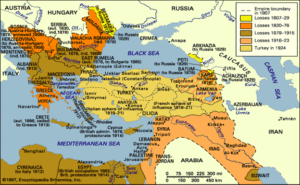
This persecution ranged from unequal treatment such as considering testimony against Muslims by Christians and Jews as inadmissible in courts of law; being forbidden to carry weapons or ride atop horses; ruling their houses could not overlook those of Muslims, to significantly more serious complaints listed for European council in 1875 including forced religious conversion, rape, extortion for protection, seizure of land, arson and murder. Around the turn of the 20th century there were periods of anti-Armenian violence including the 1894 massacre of estimated 200,000 and the 1909 massacre in Adana of 20,000
“We must, however, go back to an older time, if we want to appreciate what uncontrolled Turkish rule meant, alike to Armenians and to Greeks. It did not mean religious persecution; it meant unutterable contempt … They were dogs and pigs; and their nature was to be Christians, to be spat upon, if their shadow darkened a Turk, to be outraged, to be the mats on which he wiped the mud from his feet. Conceive the inevitable result of centuries of slavery, of subjection to insult and scorn, centuries in which nothing that belonged to the Armenian, neither his property, his house, his life, his person, nor his family, was sacred or safe from violence – capricious, unprovoked violence – to resist which by violence meant death.” British ethnographer William Ramsey in 1890
In 1908, the nationalist “Young Turk” movement overthrew the sultans of the Ottoman Empire and installed the democratic government of the Committee of Union and Progress (CUP). However despite some suggestion of fair treatment for Armenians, the CUP was primarily interested in a blood and soil nationalism for Turkey that would emphasize shared culture and religion, specifically Islam. The radical faction within the CUP would yield the rise to power of the “Three Pashas” a triumvirate of Talat, Enver, and Jemal Pasha. These three men would be the primary architects of the Armenian genocide.
When the Ottoman Turks joined World War I on the side of the Germans and Austrians, they clashed first with the British and then with the Russian allies. In their war against the Russians, the Turks were severely defeated December 1914-January1915 at the Battle of Sarikamish and they blamed the loss on the participation of Armenians, particularly those in the region of Van, within the Ottoman borders on the side of the Russians. Declaring the Armenians to be saboteurs and traitors, they ordered the arrest and execution of leading Armenian intellectuals and political leaders. April 24, 1915 will become known as Red Sunday– when 270 Armenian intellectuals in Constantinople were arrested and deported to camps. Later arrests brought totals to 2,300.
Red Sunday- April 24– will become Genocide Remembrance Day for Armenians.
The Tehcir Law (Displacement Law) was passed by the Ottoman Parliament on May 27, 1915. It authorized removal and resettlement into camps of all Armenians in the empire. On September 13, 1915, the Ottoman parliament passed the “Temporary Law of Expropriation and Confiscation” allowing all Armenian property to be confiscated by the Turks.
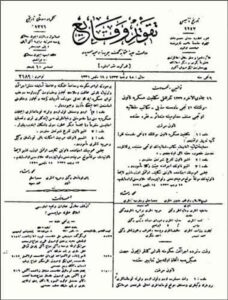
There was extensive documentation from British, German, and even American officials in the area. US Ambassador to Constantinople Henry Morgenthau wrote urgently:
When the Turkish authorities gave the orders for these deportations, they were merely giving the death warrant to a whole race; they understood this well, and, in their conversations with me, they made no particular attempt to conceal the fact. Let me repeat particular phrases used by Enver and other Turks while discussing the Armenian massacres: “The Armenians have brought this fate upon themselves.” “They had a fair warning of what would happen to them.” “We were fighting for our national existence … .. We were justified, in resorting to any means that would accomplish these ends.” “We have no time to separate the innocent from the guilty.” “The only thing we have on our mind is to win the war.”
When he received no immediate reply, he wrote again with a demand for action by the U.S.:
July 16, 1 p.m.
Have you received my 841? Deportation of and excesses against peaceful Armenians is increasing and from harrowing reports of eye witnesses it appears that a campaign of race extermination is in progress under a pretext of reprisal against rebellion.
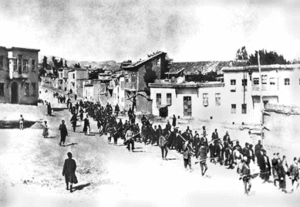
Travel to deportation centers and camps is by forced march:
“The witnesses have seen thousands of deported Armenians under tents in the open, in caravans on the march, descending the river in boats and in all phases phases of their miserable life. Only in a few places does the Government issue any rations, and those are quite insufficient. The people, therefore, themselves are forced to satisfy their hunger with food begged in that scanty land or found in the parched fields. Naturally, the death rate from starvation and sickness is very high and is increased by the brutal treatment of the authorities, whose bearing toward the exiles as they are being driven back and forth over the desert is not unlike that of slave drivers. With few exceptions no shelter of any kind is provided and the people coming from a cold climate are left under the scorching desert sun without food and water. Temporary relief can only be obtained by the few able to pay officials” –New York Times August 8, 1916
Even their German allies were disturbed by the move to annihilate the Armenian population by the Turks.
The Turks have embarked upon the “total extermination of the Armenians in Transcaucasia… The aim of Turkish policy is, as I have reiterated, the taking of possession of Armenian districts and the extermination of the Armenians. Talaat’s government wants to destroy all Armenians, not just in Turkey but also outside Turkey. On the basis of all the reports and news coming to me here in Tiflis there hardly can be any doubt that the Turks systematically are aiming at the extermination of the few hundred thousand Armenians whom they left alive until now.” – Major General Otto von Lossow acting German military attaché to Ottoman Empire
Twenty five camps were set up to contain the Armenian population but conditions were abysmal and often a lack of food and water was made more deadly by the intentional exposure to diseases like Typhus.
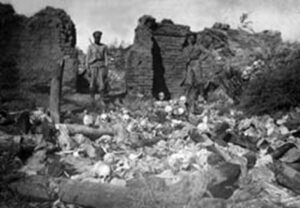
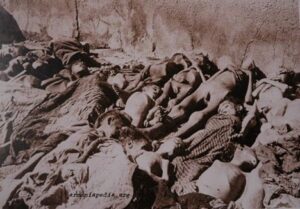
In the end, the purpose of the camps was to eliminate the Armenian population, not to contain it. Starvation, disease, violence, and deliberate murder eventually exterminated as many as 1.2 million of the 1.5 million original population.
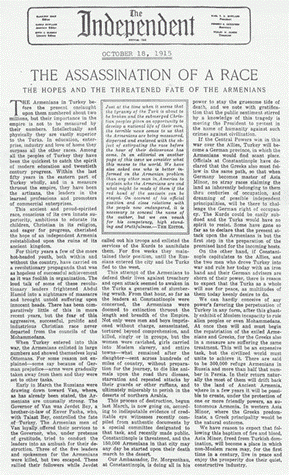
The reality of an extermination of a people under the guise and cover of a war was not hidden from the world. The New York Times wrote over 145 articles on the genocide in 1915 alone and by September 24 one headline made it clear, “500,000 Armenians said to have perished: Washington asked to stop slaughter of Christians by Turks and Kurds.”
At the end of World War I, war crimes trials were supposed to have been held. Article 230 of Treaty of Sevres was intended to punish Turk perpetrators for the “barbarous and illegitimate methods of warfare … [including] offenses against the laws and customs of war and the principles of humanity” however the British decided to waive these trials in order to have their POW hostages returned home. Since then, the new nation of Turkey has steadfastly refused to accept responsibility for the genocide claiming that those who died did so due to the harsh conditions of the war and not due to premeditated or state sponsored mass murder.
On the eve of the 100 year anniversary of the genocide, the Turks still refuse the label of genocide.
Turkey Offers Condolences to Armenians Over Killings
Prime Minister Recep Tayyip Erdogan’s office posted a web statement, but the government stood by its position that the killings of at least 1.5 million Armenians in 1915 were not a genocide. New York Times April 23, 2014
However, today over 30 nations formally recognize the genocide, including the U.S. which had delayed for over a century due to a desire to maintain an alliance in the Middle East with the nation of Turkey. Congress passed resolutions in October and December 2019, followed by President Joe Biden becoming the first president to formally use the term “genocide” on April 24, 2021.
For additional information on the genocide, consider the following sites:
http://www.armeniangenocidemuseum.org/
https://www.armenian-genocide.org/index.html
https://academic.oup.com/hgs/pages/armenian_genocide
https://encyclopedia.ushmm.org/content/en/article/the-armenian-genocide-1915-16-overview
https://www.armenian-genocide.org/genocide.html
https://www.youtube.com/watch?v=DXgrI8GlUB8
www.state.nj.us/education/holocaust/curriculum/ArmenianGuide.pdf
www.facinghistory.org/chunk/2081 – Peter Balakian
www.facinghistory.org/resources/collections/armeniangenocide
Armenian Genocide TEDx Talks at Bergen: